Wednesday, October 21, 2009

Lab 3: Neogeography

Miles of My Meals

As a college student, grocery shopping plays an integral part in my life. I have noticed that I tend to consistently eat the same thing for lunch. I eat a turkey sandwich with chips and a glass of oj. I realized that the different foods that comprise my invariable lunch meal are distributed from various places. As a result of this realization I've decided to map the distance between the location where I buy my groceries (Ralphs off Le Conte in Westwood) and places where these foods are distributed. The purpose of this map is to remind myself and other fellow consumers of the distances our meals travel before they even reach the grocery store in order to finally end up in our stomachs. It is important to keep in mind that the location from which the food is distributed is not always the place where the food is grown or produced. However, if one highlights over certain points on the map he or she may find a brief overview of the food's original place of production.


View Miles of My Meals in a larger map

One of my critiques on the My Maps application on Google Maps is the fact that for the sake of this particular map idea I feel limited to only plotting distribution locations of the components of my lunch. I wish I could show the various places and distances travelled starting from the production of the food items to processing to packaging and finally to distributing these entities to their final destination--the grocery store. Yet, plotting these points for each food item makes for a very disorganized visual representation and the message I am trying to make becomes lost in scattered dots. Furthermore, My Maps does not provide much freedom in the topographical visualization of the map nor does it give much freedom in the way my points are labeled.

Nonetheless, I believe the My Maps works as a good application for basic geographical presentations and a good starting point for those presentations that are more complex. I enjoyed the fact that I was able to Google Map something and thoughtlessly add the particular landmark to My Maps, thus, making the map constructing process quick and almost painless. I also appreciated the tutorial Youtube video Google provided for My Maps. This tutorial introduces an opportunity to provide any Internet user the potential to create a Google Map. The map’s generation will not only convey a message the creator aimed to make but it will add to the information database of the Google search engine making this message available to otherwise intangible audiences. This potentially generates yet another form of communication between people around the world and, thus, adding more gravity and more realization of topics these generated maps discuss.

When depicting messages and images on a map one is not merely telling the audience something; one is actively showing them. As the famous saying goes, “Tell me and I’ll forget; Show me and I may remember, Involve me and I’ll understand.” Because of my involvement in actively attempting to find out the distribution points and production sites of all the components that make up my daily lunch meal I now realize the power I hold in where I buy my products. Grocery stores that buy their food locally are less harmful to the environment and more often than not possess safer and healthier foods. The fact that it was so difficult to even find out where half of my items were produced brang nausea to my stomach and hopefully this map may bring about the same bizarre realizations and curiosities in consumption that I now possess.

Monday, October 12, 2009

Lab 2: USGS Topographic Maps

Analysis of 7.5 Minute Map of Beverly Hills

1. What is the name of the quadrangle?

a. The name of the quadrangle is “Beverly Hills Quadrangle” which is located in Los Angeles, California.

2. What are the names of the adjacent quadrangles?

a. The names of the adjacent quadrangles are: Canoga Park (1), Van Nuys (2), Burbank (3), Topanga (4), Hollywood (5), Venice (7), Inglewood (8).

3. When was the quadrangle first created?

a. The quadrangle was first created in 1995.

4. What datum was used to create your map?

a. The datum used to create this map was the National Geodetic Vertical Datum of 1927 and the North American Datum of 1983.

5. What is the scale of the map?

a. The scale of the map is 1:24,000

6. At the above scale, answer the following:

a. 5 centimeters on the map is equivalent to how many meters on the ground?

i. RF = map/ground = 0.5 cm X 1/24,000 X 1m/100cm = 1200 meters

b. 5 inches on the map is equivalent to how many miles on the ground?

i. RF= map/ground = 1(5in)/24,000(5in)à 5in:120,000inà120,000in/63,360in = 1.89 miles

c. One mile on the ground is equivalent to how many inches on the map?

i. RF=map/ground = 63,360in/1mile X 1/24,000 = 2.64in

d. Three kilometers on the ground is equivalent to how many centimeters on the map?

i. RF= map/ground = 3km X 100,000cm/1km X 1/24,000= 12.5cm

7. What is the contour interval on your map?

a. The contour interval on my map is 20 feet.

8. What are the approximate geographic coordinates in both degrees/minutes/seconds and decimal degrees of:

a. The Public Affairs Building;

DD: 34.07°N, -118.43°W;

D/M/S: 34°04’12”N, -118°25’48”W

b. The tip of Santa Monica pier;

DD: 34.00°N, -118.50°W;

D/M/S: 34°0’28”N, -118°30’60”

c. The Upper Franklin Canyon Reservoir;

DD: 34.12°N, -118.41°W;

D/M/S: 34°7’12”N, -118°24’36”W

9. What is the approximate elevation in both feet and meters of:

a. Greystone Mansion (in Greystone Park);

570 ft; 170.736m

b. Woodlawn Cemetery;

140ft; 42.672m

c. Crestwood Hills Park

660ft; 201.17m

10. What is the UTM zone of the map?

a. The UTM zone of the map is zone 11.

11. What are the UTM coordinates for the lower left corner of your map?

a. The UTM coordinates for the lower left corner of my map are 3763000 northing and 362000 easting.

12. How many square meters are contained within each cell (square) of the UTM gridlines?

a. 1,000,000 square meters are contained within each cell of UTM gridlines.

13. Obtain elevation measurements, from west to east along the UTM northing 3771000, where the easting of the UTM grid intersect the northing. Create an elevation profile using these measurements in Excel (hint: create a line chart). Figure out how to label the elevation values to the two measurements on campus. Insert your elevation profile as a graphic in your blog.

a.

Figure 1. Elevation profile from west to east along the UTM northing 377100, where the eating of the UTM grid intersect the northing. The points that have a yellow border are the two measurements that include the UCLA campus.

What is the magnetic declination of the map?

a. The magnetic declination is 14°

15. In which direction does water flow in the intermittent stream between the 405 freeway and Stone Canyon Reservoir?

a. The water in the intermittent stream between 405 freeway and Stone Canyon Reservoir is flowing in the North to South direction.

16. Crop out (ie. Cut and paste) UCLA from the map and include it as a graphic on your blog.


Figure 2. Graphic of UCLA cropped from the 7.5 minute Beverly Hills Quadrangle.

df


fd


Wednesday, September 30, 2009

Lab 1: SSC, SOD Survey & A Blog

Suspended in A Sunbeam


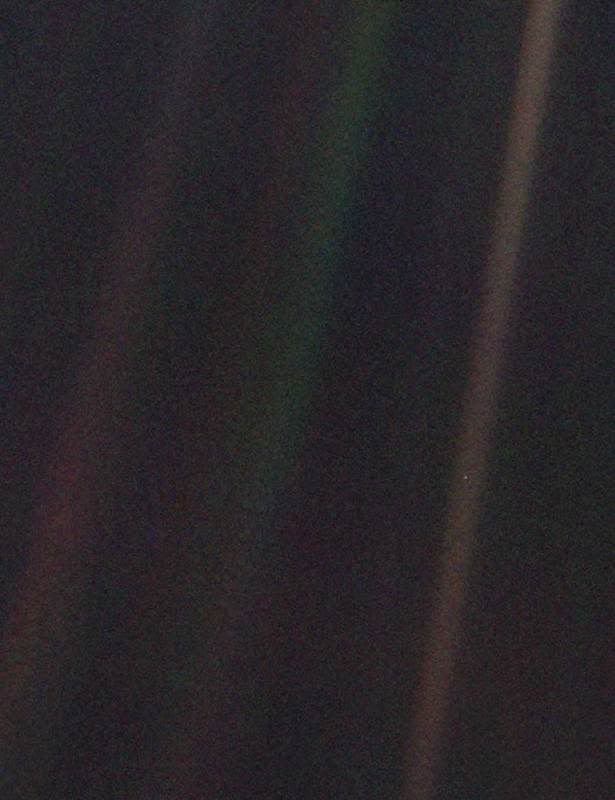
The Earth is a very small stage in a vast cosmic arena. Think of the rivers of blood spilled by all those generals and emperors so that, in glory and triumph, they could become the momentary masters of a fraction of a dot. Think of the endless cruelties visited by the inhabitants of one corner of this pixel on the scarcely distinguishable inhabitants of some other corner, how frequent their misunderstandings, how eager they are to kill one another, how fervent their hatreds. (Carl Sagan, May 11 1996)
No matter how much one tries to enlarge this photo, or how much one attempts to zoom in, the arrow will still be pointing at a "Pale, Blue Dot." This dot should certainly not be overlooked for it is the home of every plant and animal known to exist. This dot is Earth. The robotic space probe named Voyager 1 captured this image commonly referred to as "Pale, Blue Dot" in 1990 from a record distance of 3.7 billion miles. According to Nasa, the Earth takes up about 0.12 pixels of the entire picture. This particular photograph is part of a 60 image mosaic project intended to create a family portrait of the solar system that includes Earth. I believe this image holds great geographic significance because it reveals all that we know and all that we take for granted in a spatial context. It also possesses a great deal of analysis when involving the five various types of Geographic Questions. Applying those questions on a personal level this image helped me appreciate the opportunity and privilege of my attendance at a location like UCLA, my associations with the diverse people that possess diverse beliefs, and my intentions that I hold in my interactions with people. It helped me put my life and my purpose in perspective and it also solidified the curiosity I hold with geography and GIS. Carl Sagan said it best, "Like it or not, for the moment the Earth is where we make our stand."


San Francisco, San Francisco,
You Muttering Bum in a Brown Beat Suit


This is a "lit map" of San Francisco. It contains several literary artists from various cultural and countercultural movements, including the "Beat Generation," whose works are heavily associated with this city. The distribution of quotes on this particular map correlates with the quotes' reference t the location. For example, in the upper left side of the map there is a quote boxed in green that says, "The dance and the debutante met on the sly, Finding secluded spots in the new Golden Gate Park to kiss and grope, The nearby bison grumbling in their corrals." This quote, by Andrew Sean Greer, is intentionally placed within the borders of the green backround because that section is the location and extent of Golden Gate Park. I found this map very intriguing because virtually all of the quotations observed on this map display the poetic interaction these artists experienced with the area they described.


"If Geography is Prose, Maps are Iconography"
-Lennart Meri

http://yoga108.org/images/blog/2007/383.jpg,

Although I'm sure that this map was not intended to be pulled down from a whiteboard during a geography lesson in a grade school classroom, it still possesses some educational value. This map can be viewed politically; one may argue it depicts a Texan's ignorant view of the US. I also chose this conspicuously distorted map because it emphasizes the significance and the power a cartographer holds when constructing a map. It reminds me of the various names given to different countries, like Persia/Iran and Burma/Myanmar, that involve historical power struggles, which were, or still are, tied to what certain people prefer to call them. The preference is rooted in a righteous audacity and has an influential power that is commonly and heavily underestimated. Thus, why I believe it is important to be weary of such power and influence that is ranked in the study and the application of Geography and GIS.

About Me

Followers